

By The Analysts | Thought Leadership | Compressed Air Standards | System Assessments
A common mistake in explaining compressed air kWh recordings.
In the last month I have seen this three times, calling non-production demand “leak load.” It sounds minor, it is not.
When a plant is not producing, compressors may still consume power. Too often, that baseload gets labeled as leakage and treated as 100% savings potential. That potential is then used to drive commercials decision making.

But that is not always true.
Non-production demand is the air demand that remains when the plant is not in normal production. And sure, some of it may be leakage. But some ofit may be intentional demand, such as air used to:
- hold valves in position
- keep machines in a safe state
- support purge flows
- serve standby equipment
- operate controls or instrumentation
- support vacuum generation or process equipment
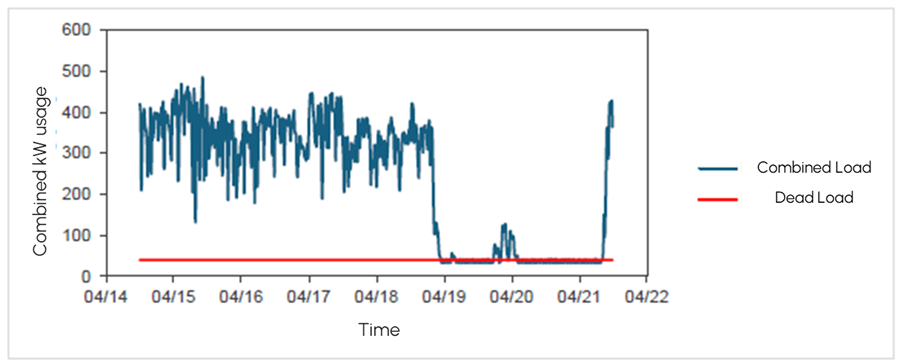
And some of it may be avoidable waste that is not technically a leak, such as inappropriate uses, artificial demand, open drains, or equipment left energized when it should be isolated. Some people call this dead load. A more neutral term is non-production demand.
That distinction matters.
Leak load is only the unintended leakage portion of the non-production demand. So, when someone assumes all weekend or off-shift compressor power is leakage, they are not measuring the system, they are guessing.
And that guess can:
- over state leak costs
- exaggerate savings potential
- misdirect recommendations
- create unrealistic payback expectations
- damage trust
This is not only a technical issue. It is a commercial one. Too many compressed air assessments are shaped around what the provider wants to sell instead of what the customer needs and want to have solved.
A good assessment starts with better questions:
1. Why is the system running this way?
2. Why does demand remain after production stops?
3. Which users are intentional?
4. Which users are avoidable?
5. Which users are actual leaks?
6. What has already been tried?
7. What problem is the customer really trying to solve?
- Energy?
- Reliability?
- Pressure instability?
- Air quality?
- Lack of visibility?
If we stop asking those questions, we are not solving problems. We are chasing squirrels.
Instrumentation still matters. A lot. But the case for instrumentation must be built honestly:
1. What are we trying to solve
2. Does single sensor give the complete picture
3. Can it be done differently with the same accuracy?
4. Does it need to be permanent?
5. Do we want to measure, manage and control the new situation in the future
And when you together decide that instrumentation is the way forward, leave little room for accuracy to become a topic, use:
- true power
- true flow
- true pressure
- true dew point
- production and non-production profiles
- a clear split between intended demand, avoidable waste, and leak load
Customers do not need another report full of assumptions. They need clarity, they need confidence and an engineered solution to create budgets that facilitate real impact, not a sales solution.
About Us
The Analysts are a brand neutral consulting firm specializing in Compressed Air Assessments, Leak detection and Leak Management, Compressor Service and System training, Process Mapping, Instrumentation, Monitoring and Controls.


